
Christmas with the Royal Choral Society 2022
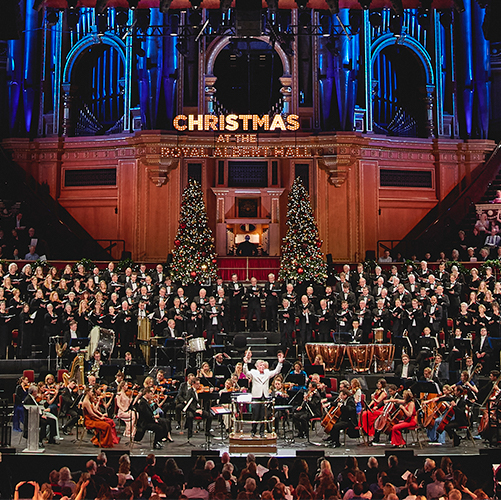
An introduction to our annual Christmas concert, Royal Albert Hall 12 December, 2022
In the Royal Choral Society’s 150th anniversary year, it will be uplifting to be back in the choir’s ‘spiritual home’ to celebrate Christmas with a feast of seasonal music. Singing or listening to carols in the lead up to Christmas is a special experience, giving us moments in which to reach back into our childhood, while the power and beauty of this music connects us to the generations who sang these songs long ago.
2022 has also seen celebrations to mark English composer Ralph Vaughan Williams’ 150th anniversary. The Royal Choral Society was conducted by Vaughan Williams himself, including his 70th birthday performance of A Sea Symphony, at the Royal Albert Hall. In our Christmas concert programme we have included his Wassail Song, first published in 1913, which is a magnificent setting of the Gloucestershire Wassail. A ‘wassail’ was an ancient toast which means something along the lines of ‘good health’, and also a traditional mulled cider that was the centrepiece of many ‘wassailing’ festivities. Vaughan Williams was one of the foremost collectors of folk songs and carols, and many of the carols that we perform nowadays, are still in existence because he saved them from oblivion.
One of our favourite carols, In the Bleak Midwinter, also marks its 150th anniversary this year. This poem by Christina Rossetti was first published under the title ‘A Christmas Carol’ in the January 1872 issue of the magazine Scribner’s Monthly. In 1906, English composer Gustav Holst set the poem to his tune ‘Cranham’ and it has remained a firm favourite ever since.
This year also marks the 350th anniversary of the death of German composer Heinrich Schütz, ‘father’ of German Baroque, who paved the way for Bach, Handel and much of the development of Western music. In our concert, the choir performs Schütz’s ‘Dank Sagan wir alle Gott’, the joyful closing chorus from his Christmas Story. It was first performed in 1660.
Other German carols also appear on the programme. Hieronymus Praetorius’ Joseph Lieber, Joseph Mein is a beautiful antiphonal carol that would have been sung at Vespers after the Magnificat during the Christmas season. A near-contemporary of Schütz, Praetorius was an organist and pre-eminent composer based in Hamburg. Although his music output was prolific he is perhaps best known for this setting of Joseph Lieber and In Dulci Jubilo, both eight-part works for double choir.
Sung in German, but in fact Austrian in origin, Stille Nacht (‘Silent Night’) is one of the all-time best-loved Christmas carols. Its composition was a collaboration between two friends, Pastor Joseph Franz Mohr who trudged through the snow on Christmas Eve 1818 to visit his friend Franz Xaver Gruber, to see if Gruber could set his poem to music in time for the Christmas Eve church service that night. Because the church organ was out of commission, the carol was performed before the altar of St Nicholas Church in Oberndorf with guitar and choir accompaniment. It must have been spellbinding. The Royal Choral Society will sing an arrangement of this carol composed during the depths of the Covid pandemic by the Royal Choral Society’s Music Director Richard Cooke. The first performance was by just 48 socially-distanced members of the choir at the Christmas concert at the Royal Albert Hall in December 2020.
From Germany and Austria, we head north to Sweden, for Jul, Jul, Strålande Jul, probably one of, if not the best-loved Christmas carol in Sweden, which deserves to be more widely known. Composed by Gustaf Nordqvist and published in 1921, the title translates as ‘Christmas, Christmas, shining Christmas’, and the song describes a glistening snow-filled scene – more Scandinavian than English, and offers blessings with a wish that Christmas brings light and peace above the blood and sounds of war.
In the season of peace and goodwill, the choir members are keeping the people of Ukraine in their thoughts, with a Ukrainian carol included as a support to the many Ukrainians in the UK and as a reminder of the ongoing war. Spy, Isuse Spy (‘Sleep, Jesus Sleep’) a lullaby by Olya Fryz arranged by Roxanna Panufnik, is being performed this year by choirs all over the UK with proceeds from buying the music going to the British Refugee Council. This work includes a stunning soprano solo, performed at this concert by Mary Bevan.
Mary also performs the aria ‘He shall feed his flock’ from Handel’s Messiah in the first half of this concert. Although this choral masterpiece is traditionally associated with Christmas, Messiah was in fact composed to be performed in the lead up to Easter. The Royal Choral Society sang the ‘Hallelujah Chorus’ from Messiah in its first season 150 years ago in 1872, but in 1876 the choir’s tradition of performing this masterpiece on Good Friday afternoon at the Royal Albert Hall began, and in the last 146 years, only the Blitz in World War Two and the Covid lockdown have prevented the annual performance. After two years where audience numbers have been adversely affected, the choir is looking forward to filling the Hall for Messiah on Good Friday, 7th April 2023: tickets for this great Easter tradition are now on sale.
The ‘Hallelujah Chorus’ will take pride of place in the celebratory programme for the Royal Choral Society’s 150th Anniversary Gala Concert on Sunday 7 May 2023 at the Royal Albert Hall. The concert will feature exceptional choral music, with all the works chosen for their special significance for the Royal Choral Society, including excerpts from works premiered in the UK by the choir (Verdi’s Requiem, Dvorak’s Stabat Mater and Panufnik’s Cradle Song) and music from composers associated with the choir (Elgar, Holst and Coleridge-Taylor), as well as a few surprises along the way. As it is also Coronation weekend, this concert of double celebration will open and close with a couple of ‘big sings’, the coronation anthems by Handel (Zadok the Priest) and Parry (I Was Glad). We are inviting the audience to join in ‘beltissimo’ with I Was Glad at the end of the concert, and help raise the roof for our new King! Tickets are now on sale, and the music for I Was Glad will be provided. If you are in a choir do spread the word!
The Royal Choral Society was saddened by the death of our former Patron, Her Majesty Queen Elizabeth, in September. Her Majesty had sent us greetings on our 150th anniversary in May and we enjoyed performing in a concert at the Royal Festival Hall in June to celebrate her Platinum Jubilee. This Christmas we remember her with affection and gratitude, and we are proud that her very first visit to the Royal Albert Hall was to our annual Christmas Concert on 15 December 1934, as Princess Elizabeth, accompanied by her mother HRH The Duchess of York (later Queen Elizabeth the Queen Mother) and sister HRH Princess Margaret.
Merry Christmas from everyone in the Royal Choral Society!
Wassail!