
Our History
The History of the Royal Choral Society


The Royal Choral Society enjoys a distinguished place in the musical life of the United Kingdom. The choir has a long and proud history that includes associations with many of the world’s greatest composers and conductors – Verdi, Gounod and Dvorák to name but three.
1871-1895
The Royal Albert Hall, officially opened on 29 March 1871, gave the capital the perfect venue for grand choral performances. Three months later, the French composer Charles Gounod, in London as a refugee from the Franco-Prussian War, conducted a choral concert at the Royal Albert Hall to mark the opening of the International Exhibition of Fine Arts and Industry. The Commissioners of the Great Exhibition of 1851, who were responsible for the Royal Albert Hall, recognised the need for a resident choir, and raised the necessary capital for its creation, inviting Gounod to be its conductor. Auditions were held in the early autumn and by October 1871 the Royal Albert Hall Choral Society had attracted over 1,000 members and began to prepare for its first concert on 8 May 1872. Gounod’s choice of repertoire pleased the distinguished audience, led by Queen Victoria, which gathered at the Royal Albert Hall and the new choir swiftly established a place in London’s musical life. Its position was consolidated late in 1872 when Joseph Barnby, celebrated trainer of ‘Mr Joseph Barnby’s Choir', succeeded Gounod as conductor and amalgamated his existing choir with the Royal Albert Hall Choral Society.
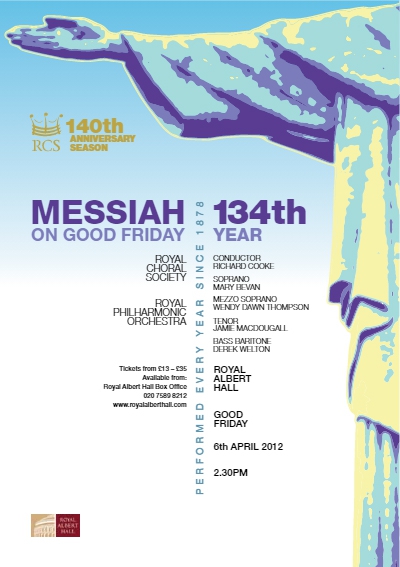
Barnby enhanced the Society’s reputation by inviting Verdi to conduct the British première of his Requiem in 1875 and Dvorák to conduct his Stabat Mater nine years later. He also established the annual Good Friday performance of Handel’s Messiah in 1876 – a tradition that continues to this day.
In its review of the musical highlights of 1888, Hazell’s Annual Cyclopedia recorded that ‘The Royal Albert Hall Choral Society, in May, gave a performance of (Arthur Sullivan’s) The Golden Legend by command of the Queen, who was present, and Mr Barnby’s force is henceforward to be called the Royal Choral Society.’ Queen Victoria’s patronage ensured a continued rise in the choir’s fortunes.
1896–1922
Following Barnby’s death in 1896, Frederick Bridge, organist of Westminster Abbey, was invited to be his successor. Bridge was a shrewd administrator and successful motivator of amateur musicians. In January 1899 the Musical Times noted that the choir comprised 242 sopranos, 174 contraltos, 174 tenors, 236 basses and sixteen so-called ‘superintendents’, a total of 842 singing members, which was ‘arranged as two separate choirs, one on each side of the (Royal Albert Hall) organ. At concerts the ladies wore white dresses, those of the right choir adding red sashes and those of the left choir blue ones. Whatever the strength or weaknesses of its vocal accomplishments, Bridge’s Royal Choral Society was certainly an impressive sight. Under his guidance, the choir contributed strongly to the remarkable expansion of music-making in Edwardian London, presenting the premières of Ethel Smyth’s powerful Mass in D and Coleridge-Taylor’s Hiawatha, and, in 1912, inaugurating the choir’s annual Royal Albert Hall carol concert.
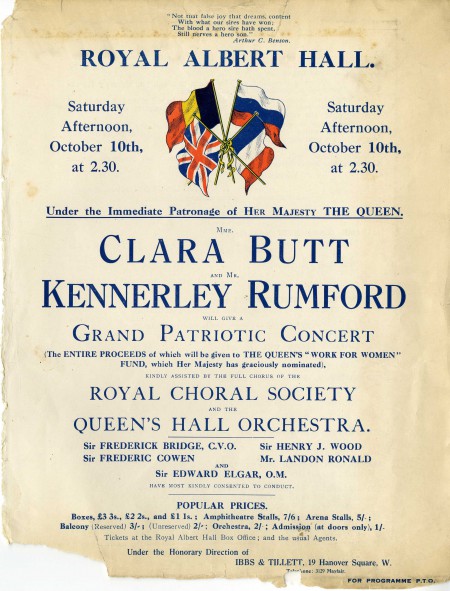
Another milestone came in 1916 with the first performance at the Royal Albert Hall of Hubert Parry’s Jerusalem, sung by the Royal Choral Society. This iconic song has been sung at the Hall more than any other (apart from the National Anthem). The origins of the song lie in the ‘Fight for Right’ campaign, created by Edward Elgar, Poet Laureate Robert Bridges, Thomas Hardy and Hubert Parry, designed to reinforce British values to the public during the war. Parry later distanced himself from the campaign and withdrew the song, and it was taken up instead by the National Union of Women’s Suffrage Societies until women got the vote in 1928, and later adopted by the Women’s Institute as their anthem.
Like Barnby, Bridge promoted the work of living British composers, conducting over 40 new works either for the first time or soon after their premières elsewhere. Faced with an inevitable decline in membership during the First World War, Bridge nevertheless managed to keep the Royal Choral Society in business, introducing a Sunday afternoon concert series at the Royal Albert Hall in 1915 and helping to preserve music-making in London. Bridge retired in 1922, making way for the Society’s long-serving organist, H.L. Balfour, to act as chorus master to a succession of guest conductors.


1923–1972
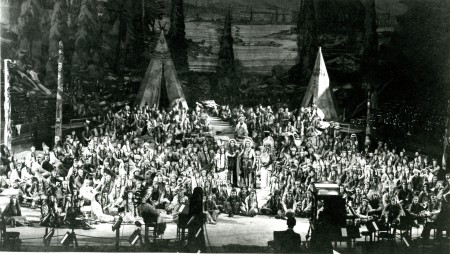
By now, the Society was attracting vast audiences to the Royal Albert Hall for its annual performances of Coleridge-Taylor’s Hiawatha trilogy of cantatas based on Longfellow’s poem Scenes from the Song of Hiawatha. The first of the trilogy, Hiawatha’s Wedding Feast, was premiered by the Royal Choral Society in 1900, conducted by Coleridge-Taylor himself. In 1924, the choir presented the first of a series of fully-staged versions of the trilogy of works, Hiawatha’s Wedding Feast, The Death of Minnehaha and Hiawatha’s Departure, performed by more than 1,000 ‘braves’ and ‘squaws’ in extended seasons each June until 1939. Audiences travelled in costume from the London suburbs and further afield, fired with an almost fanatical enthusiasm for Coleridge-Taylor’s sentimental melodies and the spectacular Royal Albert Hall productions, which included a vast painted backdrop, waterfalls, wigwams, peace-pipes and various other essential ethnic trappings.
Profits from these concerts supported the choir’s activities throughout the Great Depression and for many years after. The Hiawatha productions served as a perfect vehicle for the urbane Malcolm Sargent, who was appointed as the Royal Choral Society’s permanent conductor in 1928, a post he held for a further thirty-nine years. Sargent was universally acclaimed as the finest British choral conductor of his generation, a born leader of massed amateur singers and an immensely popular figure with audiences who might not otherwise have been attracted to classical music.
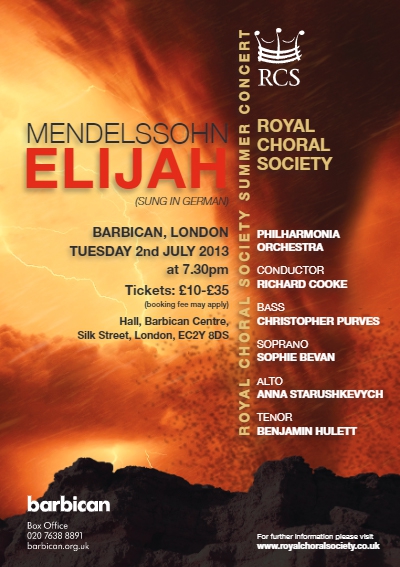
Sargent, like his predecessor Frederick Bridge, was adamant that the Royal Choral Society should continue to meet following the outbreak of war. The choir was forced, however, to relocate its home base to the relatively cramped Queen’s Hall in Langham Place when the authorities closed the Royal Albert Hall in 1939, from where it subsequently gave morale-boosting performances of Messiah, Elijah and The Dream of Gerontius. Sadly, on the night of 10 May 1941, just a few hours after the Society had performed Gerontius, the Queen’s Hall was struck by an incendiary bomb and razed to the ground during one of the Luftwaffe’s final and heaviest raids on London.
The Society’s contribution to the war effort included charity concerts and, following the destruction of the Queen’s Hall, a return to the Royal Albert Hall and ‘business as usual’.
With the end of war, Sargent and his musical team set about recruiting and training new members, their work helped by the fact that the Royal Choral Society was widely perceived as the finest symphonic chorus in the country. By the time of Sargent’s death in 1967, the choir had built a large and fine discography, had begun to tour overseas and was in good health as it approached its centenary season. Wyn Morris held the post of conductor for two seasons from 1968 until the appointment of Meredith Davies in 1972.
1972–1995
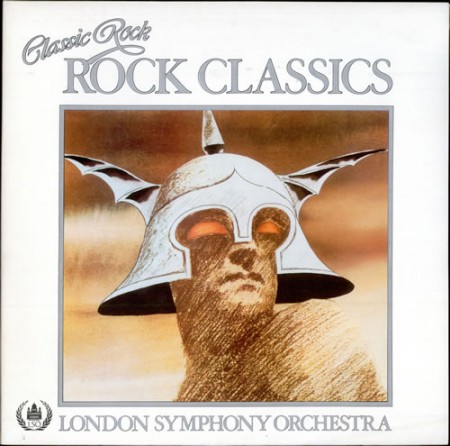
Over the final quarter of the twentieth century, the Royal Choral Society upheld the best of its traditions, promoting performances of Messiah and other Baroque works in an age that increasingly favours the ‘authentic’ treatment of music from earlier times, while adapting its activities to ensure survival. Davies and his successor Laszlo Heltay, prepared the choir for such diverse challenges as concert tours to the United States, France, Poland, Switzerland and Portugal. The premières of works by Raymond Premru, Anthony Milner and Geoffrey Burgon; festival and other appearances at important British venues, and contributions to the bestselling ‘Classic Rock’ and ‘Hooked On’ series of recordings.
Heltay’s tenure as conductor ended in December 1993. For the next two seasons, the choir was led by guest conductors (giving singers wide-ranging musical experience) and his place was taken in 1995 by Richard Cooke, previously chorus master of the London Philharmonic Choir.
1995–present
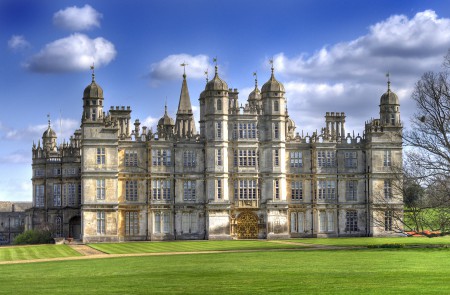
The last twenty-five years have seen a dramatic change in the UK’s choral landscape. There are now more choirs performing across the UK – both large symphonic choirs and smaller chamber groups – and the Royal Choral Society has diversified its musical activities to meet demand. In addition to concerts at the Royal Albert Hall and other venues, the choir has also performed major choral works widely in and out of London, including at the Royal Festival Hall, Westminster Abbey, St Pauls Cathedral, the cathedrals of Canterbury, Peterborough, Salisbury and Winchester, Symphony Hall Birmingham, Bridgewater Hall Manchester, Snape Maltings, St David’s Hall Cardiff and Burghley House to name but a few.


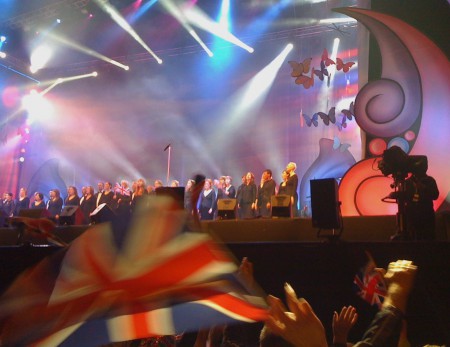
There has been close co-operation with a number of national charities with programmes of opera selections and popular choral music for gala concerts. A particularly memorable event was the Society’s 125th anniversary concert at the Royal Albert Hall on 8 May 1997 in the presence of HRH Princess Margaret and the choir’s President, HRH The Duke of Kent – 125 years to the day since the choir’s first concert in 1872. A similar event for the 150th anniversary is planned for 2022.
The Royal Choral Society returned to the recording studio in the 1990s, reconfirming its pedigree with powerful versions of Handel’s Messiah and Verdi’s Requiem, both conducted by Owain Arwel Hughes. These were followed by a chart-topping 100 Years of the Last Night of the Proms with Barry Wordsworth, and Carmina Burana with the Royal Philharmonic Orchestra conducted by Richard Cooke. In the late 1990s, the RCS appeared on television with Lesley Garrett; recorded the soundtrack for a Chanel No 5 TV and film commercial as well as the Sky Sports ‘idents’; and took part in sell-out Classical Spectaculars at the Royal Albert Hall. The choir continues to sing at this enjoyable engagement twice a year.
The Royal Choral Society performs all year round. Huge audiences at Kenwood House, Marble Hill, Glastonbury, Milton Keynes Bowl, Crystal Palace Park, Hyde Park, Horse Guards Parade & Hampton Court have enjoyed the singing of the RCS, not always under ideal conditions!
Members of the choir were received enthusiastically by vast numbers when ‘singing for England’ at international rugby matches in Paris (Stade de France) and London (Twickenham). Other unusual events which have been enjoyed by choir members include singing at the naming ceremony for Cunard’s (then) new flagship liner Queen Mary 2 in the presence of HM The Queen; annual appearances at the BBC Proms in the Park concert in front of a crowd of 40,000 revellers; and a regular slot at the Household Division’s Beating Retreat ceremony on Horse Guards Parade, where choir members have performed for the Duke and Duchess of Cambridge, the Duchess of Cornwall and also the Duke of Sussex.
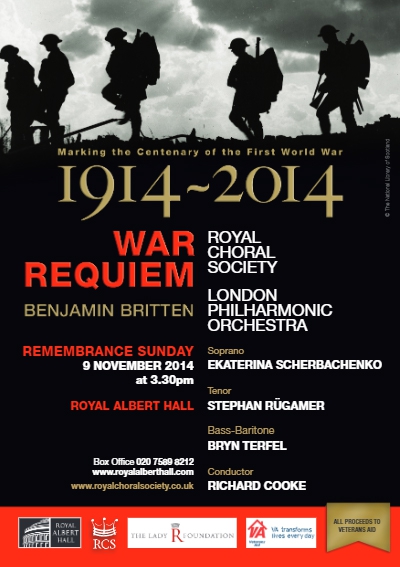
The choir has been honoured to perform at important events in the national calendar, including the 25th anniversary of the Falklands conflict; the 70th anniversary of the Dunkirk evacuation (enjoying a trip across the channel with WW2 veterans) and the centenary of the First World War. For the latter anniversary, the choir performed Britten’s War Requiem at the Royal Albert Hall with the London Philharmonic Orchestra, echoing Britten’s own plans for the première with soloists from the main protagonists, the UK (Bryn Terfel), Germany (Stephen Rügamer) and Russia (Evelina Dobraceva). The concert raised over £130,000 for the military charity Veterans Aid and was broadcast by Classic FM on Remembrance Day 2014.
The Royal Choral Society has always moved with the times and embraced performance of new works and genres. The choir has performed under the baton of Karl Jenkins several times in performances of The Armed Man and other works. Concerts of film music have also proved very popular with modern audiences, and the Society has been lucky enough to perform music by film composers John Williams and Brian Tyler, the latter conducted by the composer.
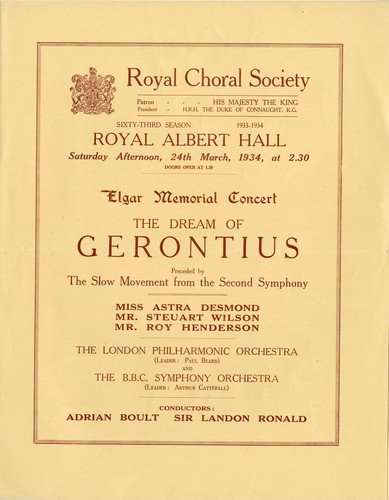
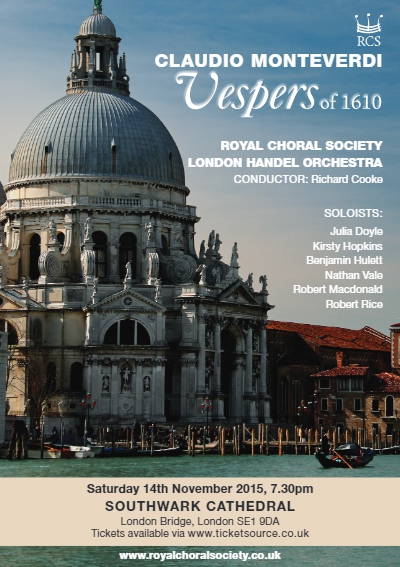
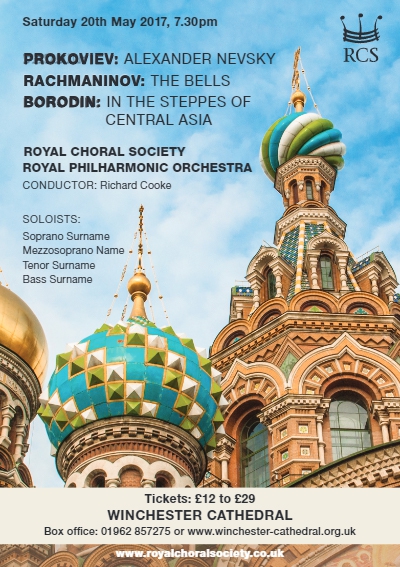
The broadening of the Royal Choral Society’s musical experience has not, however, been at the expense of the standard choral repertoire. In the last 25 years countless performances have been given of Baroque sacred music, oratorio, and twentieth century works. Highlights in recent years include Handel’s Israel in Egypt, Beethoven’s Missa Solemnis, Rachmaninoff’s All-night Vigil, Bernstein’s Chichester Psalms, Prokofieff’s Alexander Nevsky, and Monteverdi’s Vespers of 1610. The choir always enjoys performing Elgar’s The Dream of Gerontius (the choir was conducted by Elgar himself in the 1930s) and the Verdi, Brahms, Fauré and Mozart Requiems.
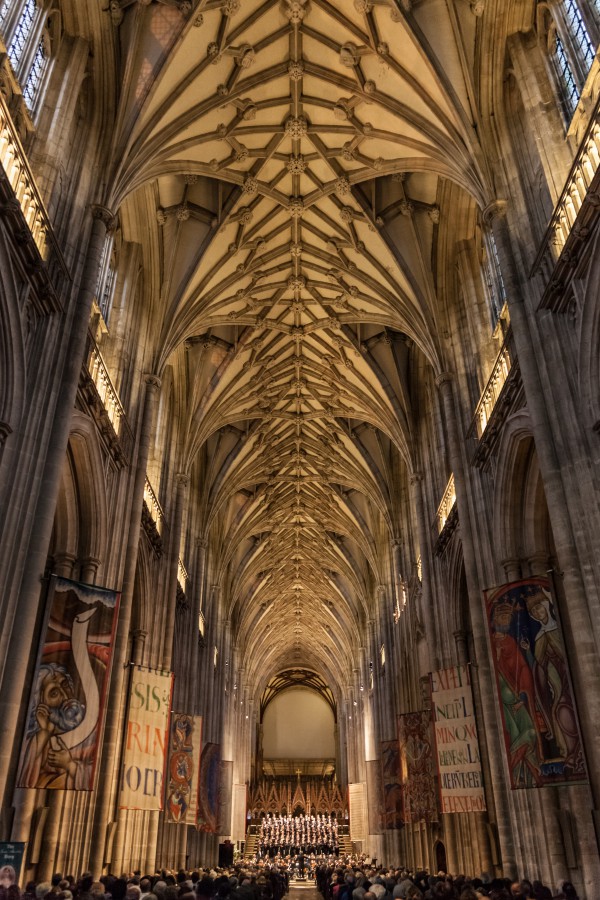
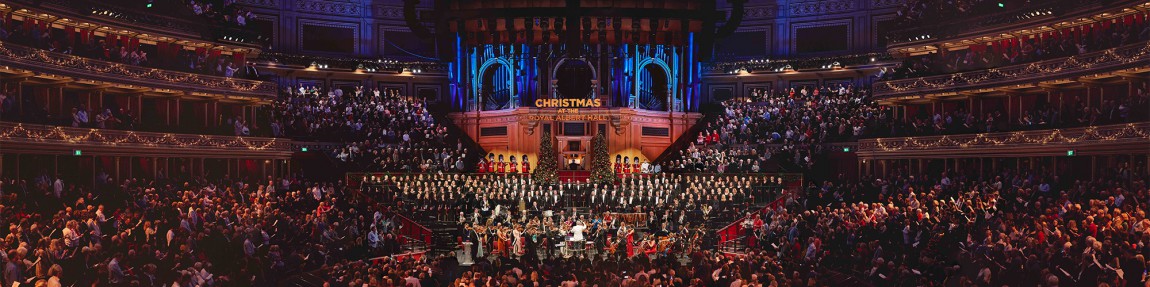
The choir’s Easter tradition of the Good Friday Messiah has become something of a national event, with near sell-out performances every year, and the choir is now firmly established in the Royal Albert Hall’s Christmas programme, taking part in eleven concerts in the 2019 festive schedule.
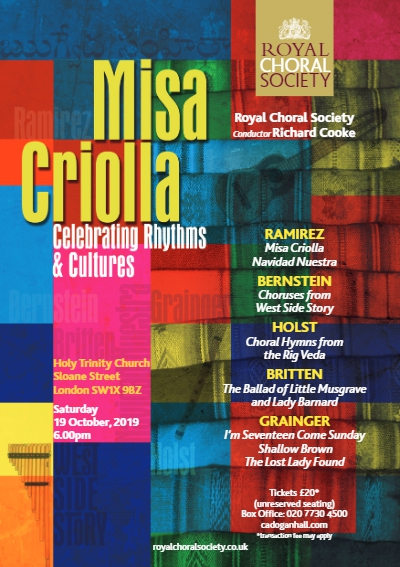
Important for a choir too is the expanding of its own musical knowledge and under the present Music Director, Richard Cooke, rarely performed works by Berlioz – The Damnation of Faust & Grande Messe des Morts – the Mahler symphonies and Schubert masses have been explored and performed to acclaim. The choir has continued its tradition of performing premières. In 1995 the choir sang the UK premiere of Ariel Ramirez’s Misa Criolla and more recently commissioned a Christmas carol from Roxanna Panufnik in memory of RCS Chairman Anthony Forbes.
Although the Royal Choral Society does not often tour abroad, there have been several foreign trips in recent years that stand out not just for the musical collaborations with orchestras but for the rewards of spending more time with fellow members. Trips to Malta, Slovakia, two visits to the USA, and a memorable trip to Germany in 2019, are particular highlights, the latter being an ‘exchange’ trip to Coburg to commemorate the bicentenaries of Queen Victoria and Prince Albert. The choir sang Vaughan Williams in Coburg following a performance in London of works by Mendelssohn and Prince Albert himself.
The Royal Choral Society now enjoys a global audience thanks to social media, particularly YouTube. The choir began releasing videos of performances in 2012 and has amassed more than 9 million views, with the Hallelujah Chorus proving to be one of the most popular pieces in the repertoire.
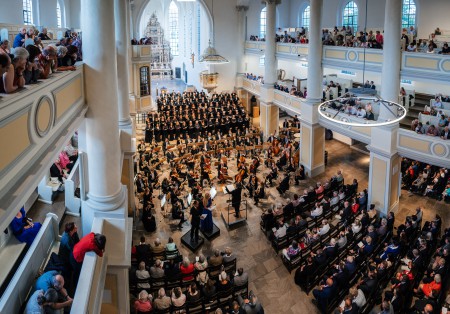
Preparations for the choir’s 150th anniversary in 2022 were interrupted by the Covid-19 pandemic. All concerts for 2020 were either cancelled or postponed except for the Christmas carol concert, which went ahead in a reduced form to a socially-distanced audience at the Royal Albert Hall. The choir has weathered a pandemic before, as well as two world wars, so members were confident that they would return to the concert platform with an even greater appreciation for the joys of choral singing. And so it proved to be, with an incredible concert to mark it's 150th anniversary, held at the Royal Albert Hall in May 2023. A packed Royal Albert Hall enjoyed a programme of choral classics associated with the choir's long history, and as it was also the coronation weekend for King Charles III, we had some enthusiastic audience participation in Parry's 'I Was Glad'. The choir is now planning the next 150 years!